
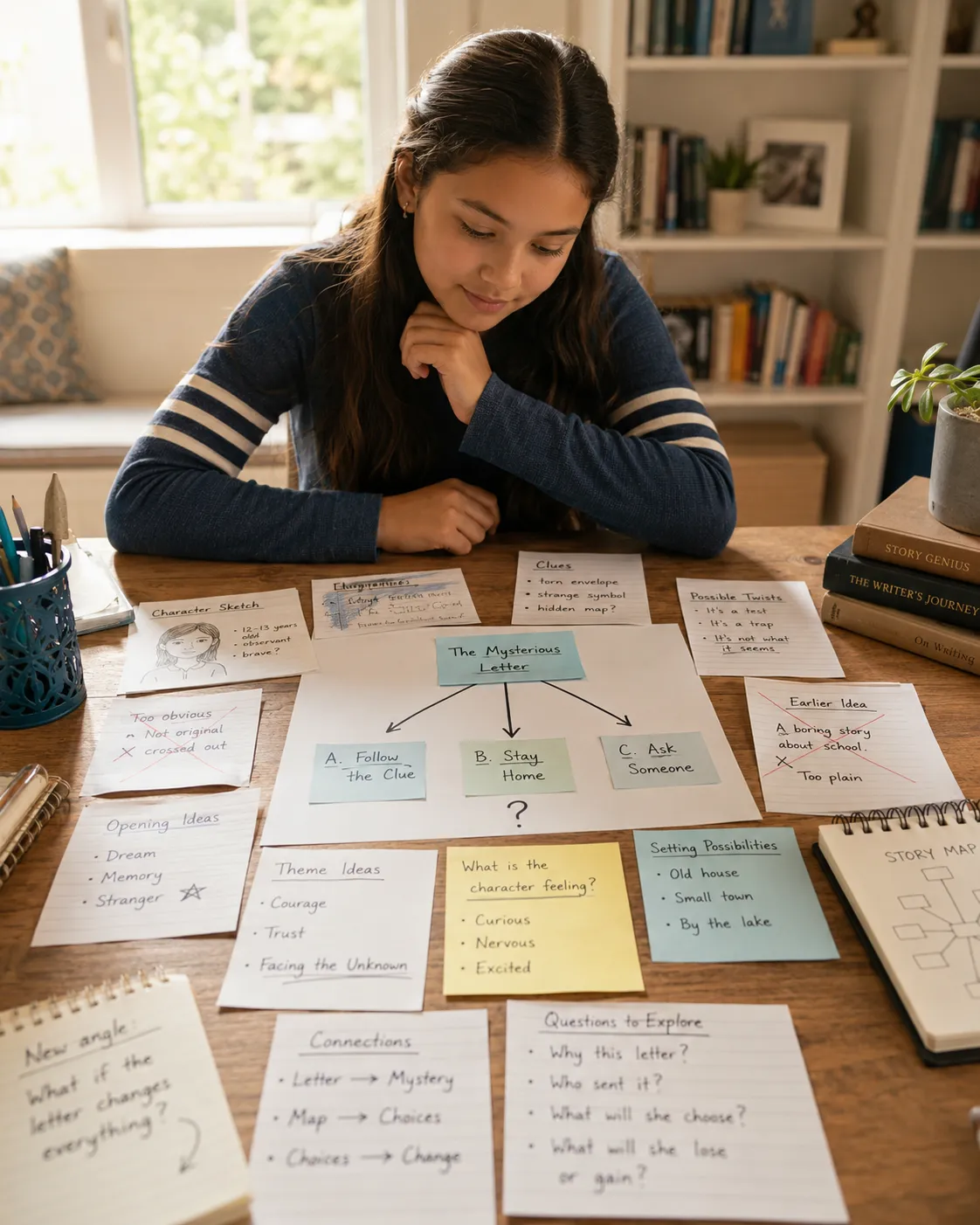
If you have been homeschooling for any length of time, you have probably had moments when you wondered how all the pieces fit together. Your student studies grammar, reads literature, works through math, learns history, explores science, and completes a variety of assignments throughout the week. Each subject has its place, and much of that work is valuable. Still, it can sometimes feel as though the school day is made up of many separate pieces that do not always come together in a meaningful way.
A student may learn a grammar rule on Monday, complete a worksheet on Tuesday, read a chapter on Wednesday, and take a quiz on Friday. The assignments get done, but the larger connection is not always obvious. A child can learn a rule, answer the questions, and finish the lesson without really having to think through how ideas relate to one another, why one choice leads to another, or how details combine to create meaning.
That is one of the reasons I believe meaningful story creation is such a powerful part of education. Stories naturally ask students to connect ideas. A story cannot really work if the pieces remain separate. The character’s goal affects the choices he makes, those choices create conflict, the conflict leads to consequences, and those consequences force the character to respond in new ways. If one part of the story changes, the rest of the story has to adjust with it.
This means that when students create stories, they are doing far more than making up characters and events. They are learning to think things through. They have to ask why something happens, what would naturally happen next, whether a character’s decision makes sense, and how one event affects everything that follows. Those questions may look like writing questions, but they are also reasoning questions.
As homeschool parents, we want our children to know facts, understand rules, and build academic skills. Those things matter. But we also want them to develop judgment, clarity, and the ability to work through ideas in a thoughtful way. We want them to recognize patterns, evaluate possibilities, solve problems, understand cause and effect, and communicate their thinking clearly.
Story creation gives students a natural place to practice all of that.
Think about a student writing a mystery. The clues have to fit together. The suspects’ actions need to make sense. The solution cannot appear out of nowhere; it has to connect to evidence that appeared earlier in the story. If the ending does not fit the clues, the student usually realizes something is wrong. The story feels unfair or confusing, and the student has to go back and think more carefully about how the pieces connect.
The same thing happens in a science fiction adventure. The world may be imaginative, but it still needs understandable rules. The protagonist’s decisions need to affect the outcome. The challenges should grow naturally from what came before. Even when the story is filled with creativity, the student is still practicing order, logic, consequences, and connection.
This is true across genres. In fantasy, historical fiction, adventure stories, realistic fiction, animal stories, and mysteries, students are constantly making decisions about cause and effect. What would this character do next? Why would she make that choice? What would change because of it? How would this event affect the other characters? How does this scene move the story forward?
Those questions help students practice a kind of thinking that reaches far beyond language arts. They are learning to see ideas in relationship to one another instead of treating them as disconnected pieces of information. They are learning that choices matter, that consequences follow actions, and that a clear sequence of ideas helps other people understand what they are trying to communicate.
That kind of thinking is becoming more important, not less. Information has never been easier to access. Students can look up facts in seconds, and artificial intelligence can produce summaries, explanations, and answers almost instantly. In that kind of world, the ability to find information is useful, but it is not enough. Students also need to know what to do with information once they have it.
Can they recognize what matters? Can they see how ideas connect? Can they compare more than one possible solution? Can they notice when something does not make sense? Can they explain their thinking in a way another person can follow? These are the kinds of abilities students will need in school, work, family life, leadership, ministry, and many real-world situations that do not come with a neat answer key.
Meaningful story creation gives students repeated practice with those skills in a way that feels personal and engaging. A story belongs to the student in a way that many assignments do not. When students are creating a story they care about, they want the protagonist to succeed, the mystery to be solved, the adventure to feel exciting, or the ending to matter. They are not simply trying to finish an assignment; they are trying to make something work.
That ownership changes the way many students approach learning. A child who rushes through a worksheet may spend a surprising amount of time thinking about a story idea. He may imagine a new scene while eating lunch. She may reconsider a character’s choice before going to bed. A student may revise a section not because someone required three corrections, but because the story does not yet feel right.
That is a very different kind of motivation. Instead of all the pressure coming from the outside, some of the desire to improve begins to come from within. As homeschool parents, we know how powerful that can be. When a child becomes invested in what he is creating, effort often begins to feel less like forced compliance and more like meaningful growth.
Revision is one of the clearest examples. Many students think revision means fixing mistakes, correcting punctuation, or changing a few sentences because a teacher marked them. Those things can be part of the process, but real revision is much richer. It teaches students to evaluate their own work, notice weaknesses, consider alternatives, and improve something they created.
In a story-centered environment, revision is not merely about finding errors. It is about asking whether the story is doing what the student wanted it to do. Is the character’s goal clear? Does the conflict build naturally? Does the ending feel earned? Would a different choice make the story stronger? Those are thoughtful questions, and they help students develop the habit of evaluating their own work with care.
The same kind of growth happens with communication. Students who create stories regularly learn to organize ideas, explain events clearly, build logical sequences, and guide readers through complex situations. Those skills do not stay inside fiction writing. They become useful in essays, conversations, presentations, future careers, leadership roles, and many other parts of life.
What encourages me most is that students can develop these skills while doing something they often enjoy. They are creating worlds, solving problems, exploring ideas, imagining characters, and telling stories that matter to them. At the same time, they are learning perseverance, creativity, adaptability, communication, critical thinking, and coherent reasoning.
In many ways, meaningful story creation reflects the way learning often works in real life. Real problems rarely arrive in neat subject-area categories. We do not usually face a grammar problem at 10:00, a history problem at 11:00, and a critical thinking problem after lunch. Real situations require us to gather information, understand context, evaluate options, make decisions, and communicate clearly.
Stories naturally encourage that kind of connected thinking because stories themselves are made of connected ideas. Every character, conflict, choice, and consequence exists in relationship to the larger whole. Students are not simply responding to someone else’s questions. They are building something. They are learning to become architects of meaning, structure, and consequence within the world of the story.
This may be one reason stories have always been such a powerful teaching tool. Long before there were textbooks, people used stories to make sense of the world. Stories helped them understand human nature, relationships, choices, consequences, courage, sacrifice, wisdom, and perseverance. Stories gave people a framework for understanding how life works.
Students still need that ability today. They need more than information. They need to organize information into meaningful patterns, understand how actions lead to outcomes, recognize connections, solve problems, and explain their thinking clearly. Meaningful story creation gives them an enjoyable and practical way to practice those skills.
That is why, at Create Great Stories, we place so much emphasis on students creating stories that matter to them. We love seeing students complete adventures, mysteries, historical fiction, science fiction worlds, realistic stories, and imaginative characters. The finished story is important, but the deeper value is found in what students develop along the way.
When students learn to create meaningful stories, they are also learning to think clearly, connect ideas, solve problems, communicate effectively, and understand how choices unfold over time. Those skills will continue serving them long after the final page has been written.
Story creation can support deeper forms of education. Many traditional assignments ask students to receive information and respond to it. Meaningful story creation invites students to build something from their own imagination while learning how ideas connect, how choices matter, and how meaning grows through structure.
That is a different kind of learning, and it is exactly the kind of learning many students need.
----------
If you would like to explore how our courses help students develop writing, communication, and critical thinking skills through meaningful storytelling, you can explore the parent overview here:
0 Comments