
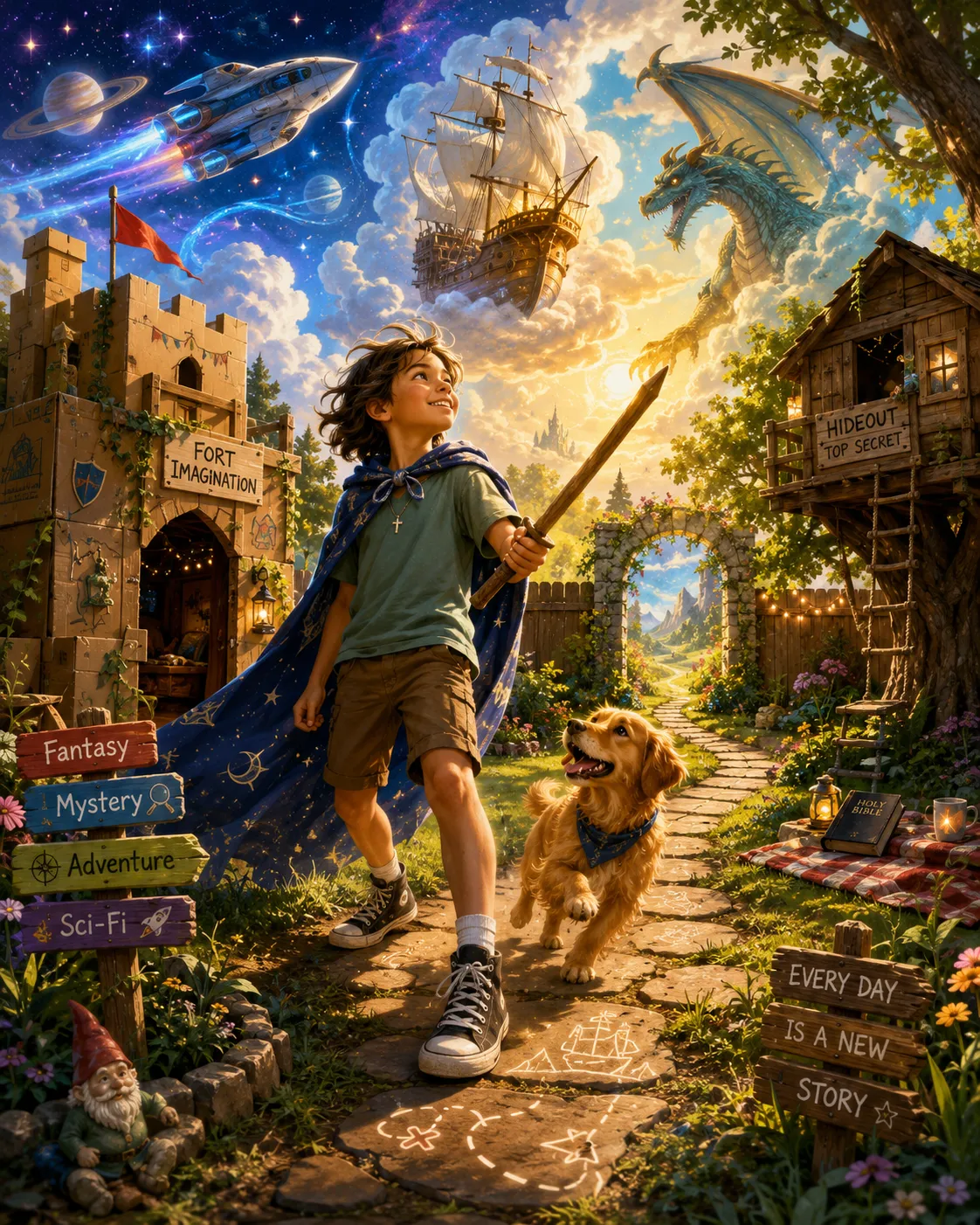
Give a child a blank page, and there is no telling what might happen.
A detective may appear, wearing a hat that is much too large and solving a mystery that somehow involves a missing sandwich. A girl may discover a secret island behind the garden shed. A boy may invent a whole civilization of talking animals, complete with a mayor, a bakery, and traffic laws that are surprisingly complicated for woodland creatures.
A spaceship may land in the backyard. A horse may save the day. A villain may change his mind. A perfectly ordinary family dog may suddenly become the wisest character in the entire story.
Children do this almost naturally. They imagine. They pretend. They ask, “What if?” A cardboard box becomes a castle. A blanket becomes a cape. The living room becomes a wilderness expedition. The backyard becomes a battlefield, a kingdom, a farm, a jungle, or the surface of a distant planet.
Long before children learn formal writing rules, they are already creating stories.
They may not know the word plot, but they know something should happen next. They may not be thinking about character motivation, but they know the hero wants something. They may not be able to explain conflict, but they know the story becomes more exciting when something gets in the way.
That love of story is not a distraction from learning. It is not something childish that we should hurry them past so we can get to “real” subjects. It is one of the most natural ways children explore ideas, choices, emotions, courage, friendship, danger, humor, and hope.
Children were made to imagine.
Imagination Is Not Wasted Time
Sometimes adults are tempted to treat imagination as a nice extra. It is pleasant, perhaps. It is cute when children are little. It makes for funny stories around the dinner table. But when it comes to serious education, imagination can seem less important than math facts, spelling rules, science lessons, history dates, and grammar practice.
Of course those subjects matter. Children need structure, knowledge, and skill. They need to learn how to think clearly and communicate well. But imagination should not be placed in a separate category called “fun but not very important.”
Imagination is one of the ways children begin to make sense of the world.
When a child invents a story, he is not only amusing himself. He is asking how things might connect. She is wondering what might happen if someone made a brave choice, a foolish choice, or a selfish choice. He is experimenting with danger and rescue, fear and courage, loneliness and friendship, failure and perseverance.
Even the silliest stories often have something meaningful hiding inside them.
A child may write about a rabbit who becomes mayor of the forest, and beneath all the silliness there may be a question about leadership. A child may write about a lost dog who finds his way home, and beneath the adventure there may be a longing for belonging. A child may write about a spaceship crew that has to work together, and beneath the lasers and blinking control panels there may be a lesson about loyalty, patience, and courage.
Children do not usually announce these things in academic language. They do not sit down and say, “Today I will explore the relationship between sacrifice and friendship through the medium of an interplanetary rescue mission.”
They just write the rescue mission.
And that is wonderful.
Children Think Through Stories
Stories give children a place to think without feeling like they are being forced to think.
That is one of the reasons fiction writing can be so powerful. A worksheet may ask for one right answer. A quiz may test whether a child remembers a fact. A grammar exercise may help a child practice a specific skill. Those can all have their place.
But a story asks a different kind of question.
What does your character want? Why does it matter? What stands in the way? What should your character do now? What happens if he gives up? What happens if she tells the truth? What happens if the friend refuses to help? What happens if the villain is not as simple as everyone thought?
These questions invite children to connect ideas. They have to think about cause and effect. They have to consider motives. They have to imagine consequences. They have to decide what kind of ending fits the journey.
That is not shallow work.
A child writing a story is practicing the kind of thinking that reaches far beyond fiction. He is learning that choices matter. She is learning that actions have consequences. He is learning that courage is usually needed when something is difficult, not when everything is easy. She is learning that a good ending does not simply stop the story; it brings the story to a meaningful place.
And because it is their story, children often care deeply about doing it well.
That matters.
When children care about what they are writing, they are more willing to revise. They are more willing to solve problems. They are more willing to search for the right word, fix confusing parts, add missing details, and make the ending stronger. They are not only completing an assignment. They are shaping something that belongs to them.
Imagination Is Part of How God Made Us
For Christian families, imagination should not be treated as something separate from faith.
God made human beings with minds that wonder, hearts that respond to beauty, and the ability to create. We do not create in the same way God creates, of course. We do not speak worlds into existence. But we do receive, arrange, shape, name, build, design, compose, draw, write, and imagine.
Creativity is not foreign to faith. It is one of the ways human beings reflect something of the Creator who made us.
That means a child’s imagination is not something suspicious by default. Like every good gift, it needs wisdom. It needs direction. It needs practice. It needs to be shaped by what is true, good, beautiful, and worthy. But the answer is not to make imagination smaller. The answer is to help children use imagination well.
This is important because stories are powerful.
Stories can shape what children admire. They can make certain choices look heroic or foolish. They can make courage, mercy, selfishness, loyalty, pride, forgiveness, or sacrifice feel real. That is one reason parents should care about the stories their children read and watch.
But we should also care about the stories children create.
If stories are powerful, then children should not only learn to avoid bad ones. They should learn to build good ones. They should learn that imagination can be joyful and wise at the same time. They should learn that stories can be exciting without being empty, funny without being cruel, adventurous without glorifying arrogance, and meaningful without becoming stiff or preachy.
A faithful imagination does not have to be dull.
It can include daring rescues, strange inventions, mysterious clues, loyal friends, talking animals, wild journeys, heroic choices, unexpected mercy, and at least one character who probably should not be trusted with the map.
The Joy of Making Something
One of the beautiful things about children and stories is how much delight they can take in making something of their own.
A child may begin with a tiny idea: a girl finds a key, a boy hears a noise in the attic, a dog runs away, a spaceship breaks down, a castle gate will not open, a friend disappears, a storm arrives at the worst possible moment.
That little idea grows. The child adds a character. Then a problem. Then a place. Then a reason the problem matters. Then another complication, because apparently the first problem was not enough. Soon the child has a whole story world forming in his mind.
This process is fun, but it is also deeply formative.
Children learn that ideas can be developed. They learn that the first version is not the final version. They learn that confusion can be clarified, weak endings can be strengthened, and flat characters can become more interesting. They learn that creativity is not merely a burst of inspiration. It is also patience, revision, and care.
That is a valuable lesson for writing, but it is also a valuable lesson for life.
Good things often begin small. Good work often needs shaping. Meaningful ideas usually become clearer as we return to them, question them, and improve them.
A child who writes stories is practicing all of this in a way that feels alive.
We Should Cultivate What Children Already Love
Children do not usually need to be convinced that stories are wonderful. They already know.
They know the joy of pretending. They know the thrill of “what happens next?” They know the fun of creating a character and then putting that character into trouble. They know that a story feels better when something is at stake.
What children need is not for adults to drain the joy out of storytelling. They need guidance that helps their stories become stronger, clearer, richer, and more meaningful.
They need to learn how to take the wild energy of imagination and shape it into a story that works. They need help understanding characters, conflict, setting, dialogue, choices, consequences, and endings. They need encouragement to keep the fun while adding depth.
That is where fiction writing becomes such a wonderful part of education.
It gives children a place to create, think, revise, laugh, problem-solve, and grow. It lets them practice writing skills inside something they actually care about. It gives them a reason to use grammar, punctuation, description, dialogue, and structure because those tools help the story become better.
And when children begin to see that their ideas can become real stories, something changes.
They are no longer only students completing assignments. They become young creators learning to communicate something meaningful.
A Blank Page Is an Invitation
A blank page can feel intimidating, but it can also be an invitation.
It invites a child to wonder. To explore. To ask, “What if?” To create someone who wants something and then discover what happens when the journey becomes harder than expected.
It invites a child to think about courage, friendship, honesty, sacrifice, perseverance, and hope without turning those words into a lecture. It invites a child to laugh, imagine, revise, and try again.
That is why children’s imagination is worth cultivating.
When a child fills a page with a detective, a hidden map, a runaway horse, a spaceship, a brave friend, a foolish mistake, or a surprising act of mercy, something more may be happening than we realize. That child is not only practicing writing. He is learning to see. She is learning to connect. He is learning to imagine with purpose. She is learning that stories can carry meaning.
Children were made to imagine.
And when we help them turn that imagination into thoughtful, meaningful stories, we are helping them use a gift God has already placed inside them.
0 Comments